How Chicken Food Manufacturers Select The Right Disposable Pop-Up Timer Specifications
How Chicken Food Manufacturers Select The Right Disposable Pop-Up Timer Specifications
For chicken food manufacturers, selecting the correct disposable pop-up timer specification is an important part of product development and production planning. Different chicken products, processing methods and market requirements may require different temperature settings, packaging solutions and product configurations.
Professional buyers usually evaluate more than product appearance or price. They consider technical specifications, application suitability, manufacturing capability and long-term supply reliability.
Understanding the key factors behind disposable pop-up timer selection helps chicken manufacturers choose solutions that better match their production requirements.
Why Product Specifications Matter In Chicken Manufacturing
Chicken products vary significantly depending on processing methods, product size, packaging format and target market.
A suitable disposable pop-up timer specification helps manufacturers achieve:
- Better product matching
- Consistent application results
- Improved production planning
- Reliable customer experience
For large-scale food manufacturers, selecting the correct specification at the beginning of a project can improve efficiency throughout the supply chain.
Understanding Activation Temperature Selection
Activation temperature is one of the most important specifications when choosing disposable pop-up timers.
Different food applications may require different temperature settings based on product requirements and customer expectations.
Professional buyers usually consider:
- Target application
- Product characteristics
- Market requirements
- Processing conditions
Working with experienced manufacturers helps companies select suitable temperature options for their products.
The Importance Of Product Size And Design Consistency
For automated food production environments, consistent product dimensions are important.
Manufacturers evaluate:
- Product size
- Structural consistency
- Packaging compatibility
- Production line requirements
Stable product dimensions help companies integrate products more efficiently into existing processes.
Material Considerations For Food Applications
Food manufacturers pay close attention to the materials used in products that come into contact with food environments.
Important considerations include:
- Food-grade material selection
- BPA-free design
- Manufacturing consistency
- Product safety information
Professional suppliers provide clear product information to support responsible purchasing decisions.
Choosing Between Bulk And Retail Packaging
Chicken manufacturers purchase disposable pop-up timers for different business models.
Bulk packaging is commonly selected by:
- Large poultry processors
- Food factories
- Industrial kitchens
- OEM manufacturers
Retail packaging may be suitable for:
- Private label products
- Supermarket products
- Consumer-facing packages
The right packaging format depends on the customer's sales channel and production process.
OEM Customization Requirements From Chicken Companies
Many chicken manufacturers require customized solutions rather than standard products.
OEM customization may include:
- Activation temperature customization
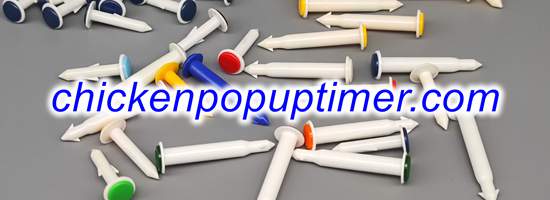
- Button head color customization
- Logo injection molding
- Packaging customization
- Private label solutions
Flexible customization allows food companies to create products that match their market positioning.
Why Manufacturers Should Evaluate Supplier Capability
The same product specification may perform differently depending on manufacturing consistency and quality control.
Before selecting suppliers, chicken manufacturers should review:
- Manufacturing experience
- Production capability
- Quality management
- Export experience
- Technical communication ability
A capable supplier provides confidence throughout the product lifecycle.
How Direct Factory Cooperation Supports Better Decisions
Direct communication with manufacturers allows buyers to discuss technical requirements more effectively.
Direct factory cooperation helps companies:
- Understand available specifications
- Develop customized solutions
- Improve communication efficiency
- Create stable supply relationships
For professional food companies, supplier knowledge is an important part of successful product development.
Frequently Asked Questions
What specification is most important for disposable pop-up timers?
Important specifications include activation temperature, size, materials, packaging and application suitability.
Can chicken manufacturers customize activation temperature?
Yes. Professional manufacturers can provide customized temperature options.
Why is product size consistency important?
Consistent dimensions help manufacturers integrate products into production and packaging processes.
Can disposable pop-up timers be supplied in bulk packaging?
Yes. Bulk packaging is commonly used for industrial food production.
Can private label brands customize packaging?
Yes. OEM packaging options can be developed according to customer requirements.
Why should buyers choose specialized manufacturers?
Specialized manufacturers provide deeper product knowledge and more focused production support.
What should chicken companies review before purchasing?
They should review specifications, materials, quality information and supplier capability.
DISCLAIMER
"Pop-Up Timer", "Chicken Pop-Up Timer" and "Disposable Cooking Thermometer" are generic industry terms used to describe disposable food temperature indication products.
We are an independent Chinese direct-source manufacturer specializing in disposable pop-up timers and temperature indicators since 2006. We are not affiliated with VOLK or any other third-party brand.
Any references to brands, companies or industry terminology are provided only for identification, comparison and professional procurement evaluation purposes.